

What Happens When You Find a Block on Bitmern Solo
From find to wallet: Bitmern Solo takes a flat 1% on the block you find; you keep 99% paid to your address. Receipt walkthrough — no invented find frequency.
Solo payouts should read like a receipt, not a mystery. Here is the short path from find to wallet, then the full walkthrough.
When your hashrate finds a block on Bitmern Solo, the pool takes a flat 1% of that block’s reward and sends the remaining 99% to the wallet address in your miner username. No subscription - the fee applies only on successful finds.
That is the whole payout story. This page sets expectations for what happens after a find, what the dashboard and alerts actually do (monitoring is not a find), when a shared pool still makes more sense for cash flow, and how an illustrative BTC receipt looks on paper. It does not invent how often you will find a block, network odds, or Bitmern Solo win history. Fee math and product framing: Bitmern Solo Fees Explained. Payout-model basics: Solo Mining vs Pool Mining. Host fit in 2026: Bitmern Solo vs CK Pool vs Public Pool.
The find-to-wallet path in plain steps
Treat a find as an ops event with a short checklist - not a jackpot montage.
- Your work solves the block - shares attributed to your wallet.worker on Bitmern Solo’s stratum contribute to a valid block for that coin. Solo means your find owns the reward path (minus the pool fee), not a fractional share of someone else’s block.
- Gross reward is known - block subsidy plus any transaction fees included in that block for that chain. Exact totals vary by coin and by what landed in the block; the fee rate does not.
- Flat 1% pool fee - Bitmern Solo deducts 1% of that total reward. There is no second cut for “withdrawal processing” on top of this pool fee in the public model.
- 99% to your wallet - the remaining 99% goes to the receive address you use as the username prefix (and register on your account for that coin). Format on the miner:
YOUR_WALLET_ADDRESS.workerName. - Record stays auditable - earnings / payout history is there so you can match gross, fee line, and net later - the same three questions a store receipt answers.
No block found means no pool fee for that stretch. Connecting workers, opening the dashboard, and leaving hardware pointed at stratum do not generate a subscription invoice. Dry spells are part of solo physics; the product does not bill you for waiting.
Illustrative BTC receipt (site example - not a forecast)
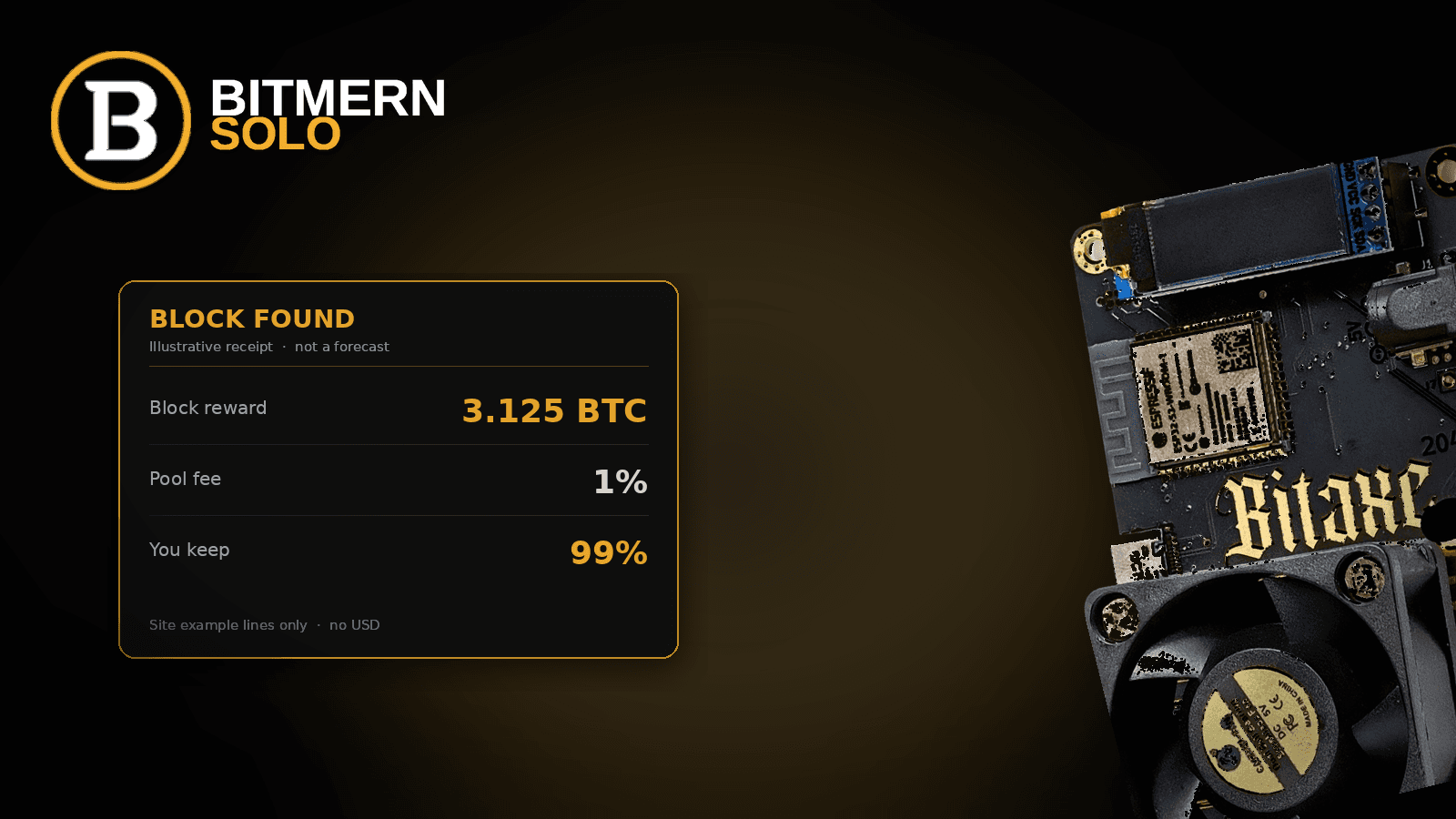
The numbers below match Bitmern Solo’s public site example. They are labeled illustrative. They are a receipt template for fee arithmetic - not a prediction of when you will find a block, how often finds occur, or what any future block will pay in fiat.
Line Amount Block reward (illustrative BTC figure from site) 3.125 BTC Pool fee (1%) 0.031 BTC You receive 3.094 BTCRead it top to bottom:
- Gross: illustrative block reward used on the site (3.125 BTC).
- Fee line: flat 1% of that reward (shown as 0.031 BTC on the site).
- Net to wallet: 99% (shown as 3.094 BTC on the site).
Same rate logic applies on other supported coins: take the block’s total reward, keep 99%, send that to the coin wallet in your username. Subsidy sizes and fee totals change with halvings and chain rules; the pool fee stays a flat 1% of whatever that total is when you find the block.
Do not convert those BTC lines into invented USD “wins” for marketing. If you need dollar context, use live market data yourself after a real find - this article stays on the site’s illustrative BTC lines only.
Direct wallet payout - what you configure
Rewards go to the wallet in your username. That is intentional:
- Configure
YOUR_WALLET_ADDRESS.workerNameon the miner (passwordxon Bitmern Solo). - Register the same coin wallet on your Bitmern Solo account so the dashboard maps workers and history to your login.
- When a block matures on the pool’s payout path, the model is automatic: deduct 1%, send 99% to that wallet. You are not filing a ticket so the pool’s cut can clear.
Wrong wallet prefix, wrong coin tab, or a typo in the address is an ops problem before it is a “payout delay” story. Prove workers and shares on the dashboard first; payouts only matter after a find exists to settle. Supported coins under the same fee rule include BTC, LTC, DOGE, BCH, DGB, XEC, ETC, ZEC, XMR, RVN - one account, flat 1% on finds, same receipt idea on each coin.
What the dashboard and alerts do (and do not promise)
A healthy dashboard means your hardware is talking to stratum and attributed correctly. It does not mean a block is imminent.
What monitoring and alerts are for:
- Confirm workers appear, hashrate maps, and shares climb while boards are on
- Catch downtime and hashrate drops so a silent farm does not stay silent for days
- Surface payout / earnings history after real activity so past finds stay checkable
- Give you an ops surface without self-hosting a full stratum stack
What they are not:
- A promise that Current Effort, shares, or uptime will produce a find on any schedule
- A luck meter that “unlocks” a block when a bar fills
- A substitute for understanding solo variance - full upside on your finds, and possible zero income on that coin between finds
- Proof that someone else’s find on the platform pays you (it does not - solo finds pay the finder)
Turn alerts on after the first clean worker row so the next outage pages you. Keep expectations honest: monitoring ≠ a find. Effort and share counters are operational truth, not a countdown clock.
Setting expectations without inventing odds
Solo mining is probabilistic. Relative hashrate versus network difficulty dominates short windows. This article will not invent:
- How often you will find a block
- Network-wide odds dressed up as Bitmern Solo guarantees
- A list of Bitmern Solo “wins” or fake jackpot screenshots
- Dollar overlays on top of the illustrative BTC receipt
What you can set expectations around instead:
- Fee clarity - flat 1% only when you find; keep 99%
- Payout path - wallet in the username; receipt-style gross / fee / net
- Ops clarity - dashboard and alerts reduce blind spots; they do not buy luck
- Cash-flow clarity - between finds, that coin’s mining income can be zero
If you need paycheck-style fractional credits on a weekly rhythm, that is a different product class - covered next.
When a shared pool still fits
Bitmern Solo is the right fee model when you want maximum take-home on your finds and can absorb high variance. Shared pools still fit when constraints are different.
Stay on (or keep) a shared pool if you:
- Need predictable cash flow - weekly (or more frequent) fractional credits to cover power, hosting, or debt service
- Cannot tolerate long gaps without a coinbase-style credit on a given coin
- Prefer accounting that looks like a payroll stub rather than occasional large receipts
- Are still stabilizing uptime and want income smoothing while ops mature
Solo (Bitmern Solo’s model) fits when you:
- Accept variance in exchange for 99% of blocks you find after a flat 1%
- Want a transparent receipt and direct wallet settlement
- Already run hardware across one or more supported coins and want stratum, monitoring, and alerts without self-hosting
- Do not need daily fractional credits on that coin to keep the lights on
Neither choice is smarter in the abstract. Shared pools sell smoothed cadence. Solo sells full upside on your finds. Fee percentage is second-order next to which cash-flow shape you need. Deep comparison of solo hosts (fees and fit, verify competitors at source): Bitmern Solo vs CK Pool vs Public Pool 2026. Model contrast: Solo vs pool mining.
Soft next step
If you need weekly cash from fractional pool credits, keep a shared pool in the mix. If you want a transparent find receipt - flat 1%, keep 99%, paid to your wallet - Bitmern Solo is built for that path.
Start mining
Point your miners at Bitmern Solo, register the wallet that matches your username, and keep 99% of every block you find.
Start Mining → https://www.bitmernsolo.com/
The fee page on the site remains the source of truth if operations ever change. This article mirrors that public model: one percent on success only, wallet direct, monitoring as ops - not as a promise of a find.
FAQ
What happens when I find a block on Bitmern Solo?
Bitmern Solo takes a flat 1% of that block’s total reward and sends the remaining 99% to the wallet address in your miner username (registered for that coin). No subscription fee for idle hashrate.
Is the 3.125 / 0.031 / 3.094 BTC example a real payout promise?
No. Those figures are the site’s illustrative BTC receipt for fee arithmetic. They are not a forecast of find timing, frequency, or fiat value.
Where does the payout go?
To the wallet prefix in YOUR_WALLET_ADDRESS.workerName. Register that same coin address on your account so dashboard history maps correctly.
Do dashboard alerts mean I am about to find a block?
No. Alerts and monitoring help you catch downtime and confirm workers/shares. They do not promise a find. Monitoring ≠ a find.
Do I pay the 1% if I have not found a block?
No. No find means no pool fee for that period. Connecting and watching the dashboard does not create a subscription charge under this model.
When should I use a shared pool instead?
When you need predictable weekly (or similar) cash flow from fractional credits and cannot absorb solo dry spells on that coin. Solo optimizes for full upside on your finds; shared pools optimize for smoothed cadence.
Where can I read the fee model and solo vs pool basics?
Bitmern Solo fees (1%), solo vs pool mining, and Bitmern Solo vs CK Pool vs Public Pool 2026. Homepage: bitmernsolo.com.