

Bitmern Solo Fees Explained: 1% on Blocks You Find
Bitmern Solo charges a flat 1% on block rewards you find - you keep 99%, paid to your wallet. No subscription. See the BTC receipt example and what’s free.
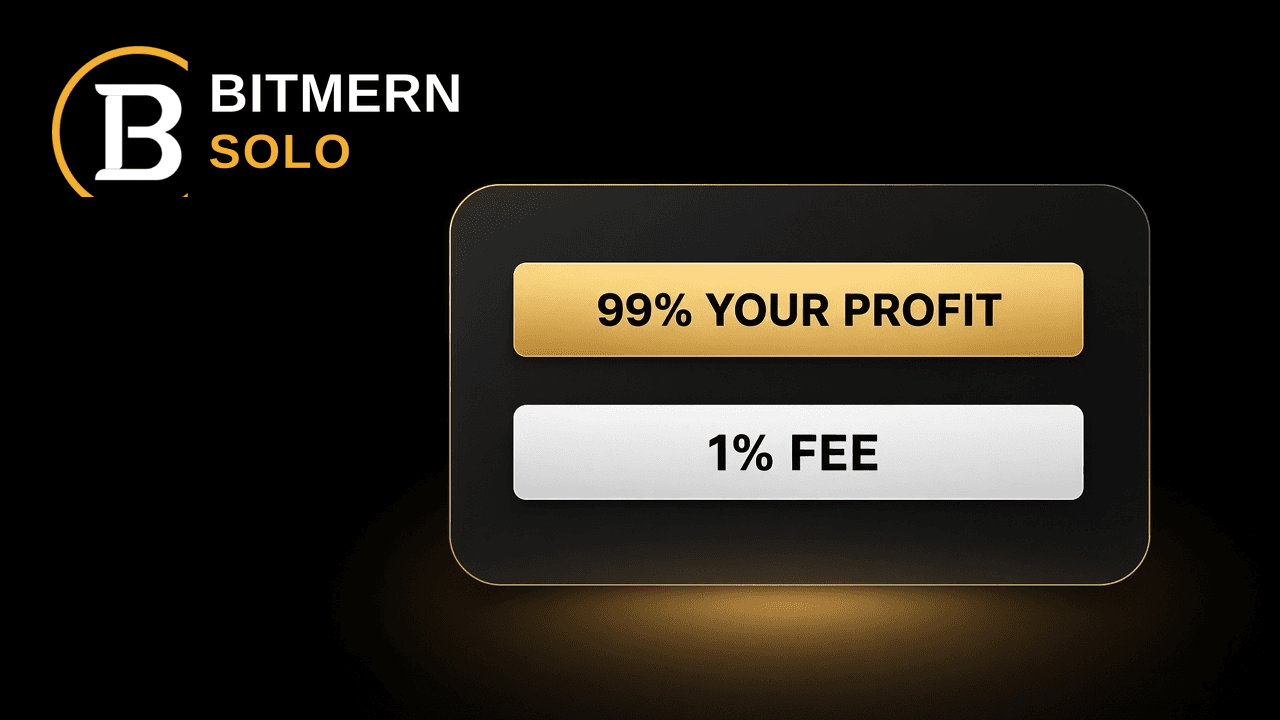
Fees should read like a receipt, not a pitch. Here is the short version, then the walkthrough.
Bitmern Solo charges a flat 1% on block rewards you find. You keep 99%, paid to your wallet address. No subscription - 1% is the pool fee on successful blocks.
That is the whole pricing model. No monthly plan, no tier gates, no fee on idle hashrate. If you do not find a block, you owe nothing to the pool for that period. The rest of this page spells out what the 1% covers, what stays free, how an illustrative BTC payout looks on paper, and who this model fits versus who should stay on a shared pool.
What the 1% is (and is not)
What it is: a pool fee taken only from the total block reward when your hashrate finds a block. The total includes the block subsidy plus any transaction fees in that block. Bitmern Solo deducts 1% and sends the remaining 99% to the wallet address you use in the miner username (and register on your account for that coin).
What it is not:
- A subscription or recurring charge
- A fee on every share or every hour of hashing
- A cut of rewards other miners find on the same platform
- A withdrawal fee layered on top of the pool fee
- A premium unlock for monitoring, alerts, or multi-coin access
No block found means no pool fee. Solo mining is probabilistic; dry spells happen. During those stretches, Bitmern Solo does not bill you for connecting workers, viewing the dashboard, or leaving hardware pointed at stratum.
Rewards go to the wallet in your username. Configure YOUR_WALLET_ADDRESS.workerName on the miner. When a block matures, the payout path is automatic: deduct 1%, send 99% to that wallet. You do not file a withdrawal ticket for the pool’s cut to clear.
Supported coins under the same fee rule: BTC, LTC, DOGE, BCH, DGB, XEC, ETC, ZEC, XMR, RVN. One account, flat 1% on finds, same principle on each coin.
Illustrative BTC receipt walkthrough
Treat this as a receipt template, not a forecast of how often you will find a block. Numbers below match Bitmern Solo’s public site example and are labeled illustrative.
Line Amount Block reward (illustrative BTC subsidy figure from site) 3.125 BTC Pool fee (1%) 0.031 BTC You receive 3.094 BTCRead it top to bottom the way you would a store receipt:
- Gross: the block’s reward amount used in the site example (3.125 BTC).
- Fee line: 1% of that reward (shown as 0.031 BTC on the site).
- Net to wallet: 99% (shown as 3.094 BTC on the site).
Same arithmetic applies on other coins: take the block’s total reward, keep 99%, send that to your coin wallet. Exact subsidy sizes change over time with halvings and chain rules; the fee rate stays flat at 1% of whatever that total reward is when you find the block.
The receipt metaphor matters for trust. You should always be able to answer three questions after a find: what was the gross reward, what was the 1% line, and what landed in the address you configured. Bitmern Solo’s model is built so those three lines are the whole story - not an invoice plus extras.
What’s included free
The 1% is not a stripped-down “hash only” product. With every account, Bitmern Solo includes tools that would otherwise mean running your own stratum stack or paying a separate SaaS bill:
- Real-time monitoring - hashrate, workers, shares, and related live views so you can see whether hardware is actually talking to stratum
- Email alerts - downtime, hashrate drops, and payout notices so a silent farm does not stay silent for days
- Ten coins from one account - BTC, LTC, DOGE, BCH, DGB, XEC, ETC, ZEC, XMR, RVN with dedicated stratum endpoints
- VarDiff stratum - multiple ports so difficulty can track your hashrate instead of forcing a one-size port
- Mining profitability calculator - hashrate-in, probability framing against live network data (use it as a planning aid, not a guarantee)
- Full earnings history - payout records with explorer links so past finds stay auditable
Also free in practice: account creation, worker connections, dashboard access, switching coins by pointing miners at a different host, and API access as listed on pricing materials. No credit card is required to open an account and start submitting shares.
You are paying for successful-block infrastructure (stratum, validation, broadcasting, payout rails), not for the privilege of looking at charts.
How this differs from shared-pool fees
A lower headline percentage is not the main difference. The product differs.
On a typical shared pool, you and many other miners contribute hashrate to a common effort. When the pool finds blocks, rewards are split by share contribution (scheme details vary). Fees in that world often sit in a ~2-3% band, as Bitmern Solo’s own pricing comparison states for typical shared pools. Those fees usually apply on the fractional payouts you receive - which means you pay the pool cut on a steady drip of small credits, not only on rare full-block events.
On Bitmern Solo:
Dimension Bitmern Solo Typical shared pool (band from site) Pool fee Flat 1% Often ~2-3% When fee applies Only on blocks you find Typically on ongoing payouts Who owns the block reward Finder keeps 99% Split across participants Subscription None Sometimes present elsewhere Variance High (full upside, dry spells) Lower (smoothed fractions)Solo is not “shared pool, but cheaper.” Shared pools sell certainty of cadence: frequent fractional income with group luck smoothing variance. Solo sells full upside on your finds: when your work solves a block, nearly the entire reward is yours, minus the flat 1%. Between finds, that coin’s mining income can be zero.
If you only compare 1% to 2-3% and ignore payout ownership, you will pick the wrong product. Fee rate is a second-order detail next to whether you want jackpot-style economics or paycheck-style economics.
Who this fee model fits / who should stay pooled
This fee model fits operators who:
- Can absorb high variance - long gaps between finds are normal at modest hashrate relative to network difficulty
- Want maximum take-home on a find rather than a diluted share of many pool finds
- Prefer a transparent receipt: one percentage, only when a block hits, paid to a wallet they control
- Already run or plan to run hardware across one or more of the ten supported coins and want stratum, VarDiff, monitoring, and alerts without self-hosting Miningcore
- Do not need daily fractional BTC (or other coin) credits to cover power bills in the short term
Stay on a shared pool if you:
- Need predictable cash flow to cover electricity, hosting, or debt service on a short schedule
- Cannot tolerate weeks (or longer) without a coinbase credit on a given coin
- Prefer accounting that looks like a payroll stub rather than occasional large receipts
- Are still learning hardware ops and want income smoothing while you stabilize uptime
Neither choice is “smarter” in the abstract. They optimize for different constraints. Bitmern Solo’s 1% is honest for the solo product: you pay when you win a block, you keep almost all of it, and the free tooling is there whether you have found anything this month or not.
Soft next step
Shared pools remain the right call if you need predictable cash flow. If you want a transparent receipt - flat 1% on blocks you find, 99% to your wallet, no subscription - Bitmern Solo fits.
Start mining
Point your miners at Bitmern Solo and keep 99% of every block you find.
Start Mining → https://www.bitmernsolo.com/
The fee page on the site stays the source of truth if anything in operations ever changes; this article mirrors that public model: one percent, success only, wallet direct.