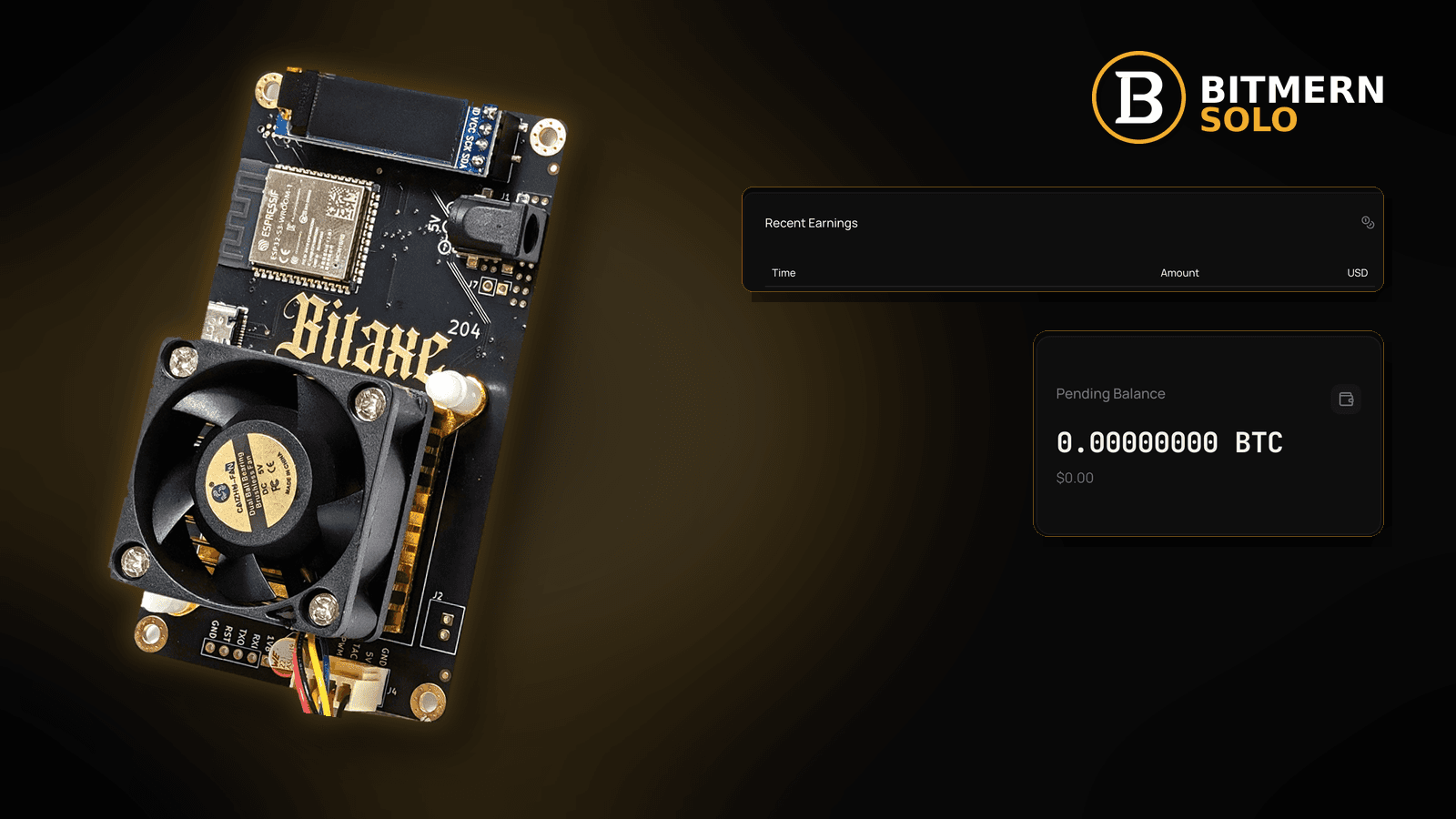
Proof of Work Explained: Why Your Bitaxe Hashes Thousands of Times a Second
Proof of work (PoW) is Bitcoin's rule that a new block only counts if its header produces a double SHA-256 hash at or below the current network target. There…
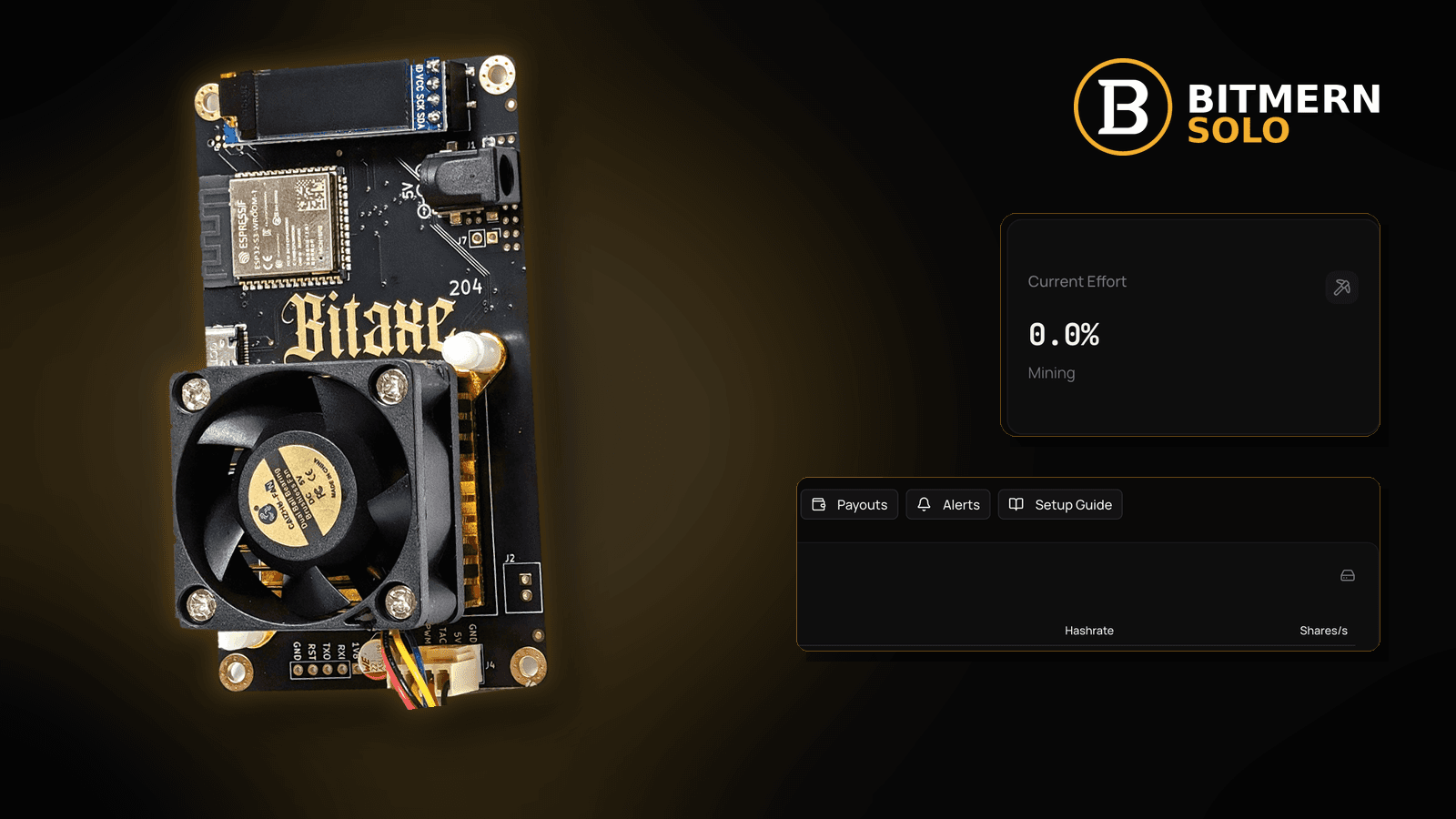
Your Bitaxe sits on a shelf, its fan humming, and as far as you can see it does nothing. No screen fills up, no coins appear, and most days nothing at all happens on the dashboard except a steady stream of accepted shares. Yet every second it is running the same small test over and over again, far faster than any person could count. That test is proof of work, and it is the reason Bitcoin can agree on one history without anyone in charge.
Proof of work (PoW) is Bitcoin's rule that a new block only counts if its header produces a double SHA-256 hash at or below the current network target. There is no shortcut to finding such a hash: the only known method is to try candidate after candidate until one happens to land low enough. That trying is what your Bitaxe does. Because valid blocks are expensive to produce and cheap to check, rewriting history would mean redoing the work. On a pool, your miner proves its effort with shares — easier hashes that are not blocks. On Bitmern Solo, keep BTC easy-start host btc.bitmernsolo.com with port :3132, username WALLET.worker, password x. Current Effort is not a find guarantee.
This post is the "why the work exists at all" lane. If you want the mechanics of the hashing loop itself, read what is a nonce. If you want to know how the target moves over time, read difficulty adjustment explained. Here we stay on the idea underneath both.
Bitmern Solo is solo infrastructure: flat 1% fee on finds only, you keep 99%. Nothing in this post is financial advice, and nothing here promises a find.
The one-sentence version
Proof of work is a lottery where every ticket costs real electricity, and the winning ticket is easy for everyone else to check.
The rest of this post unpacks why that simple rule does so much.
The problem proof of work solves
Bitcoin is a shared ledger run by thousands of independent computers that do not know or trust each other. At any moment, some of them will hear about different transactions in a different order. Someone has to decide which version becomes the next page of history.
Voting by computer does not work on an open network, because anyone can spin up a million fake computers for free. Voting by identity does not work either, because there is no one to hand out identities. Bitcoin needed a way to pick the next block that:
- Cannot be faked cheaply — you cannot pretend to have done it.
- Can be checked instantly — every node can verify it without trusting the sender.
- Is open to anyone — no permission, no account, no sign-up with a central party.
Proof of work meets all three. The "vote" is the work itself. A block carries its own evidence that real computation was spent to make it.
What "work" actually means
Every block has a small summary called a block header. Bitcoin runs that header through SHA-256 twice — double SHA-256 — and gets a 256-bit number back. You can think of that number as a random-looking ticket.
The network sets a target. A block is valid only if its header hash is at or below that target. Most hashes are nowhere near low enough, so they are thrown away.
Here is the key property of SHA-256: you cannot predict the output from the input. Change one bit of the header and the hash changes completely. There is no clever math that lets you steer toward a low hash. So the only practical strategy is:
- Build a header.
- Hash it.
- Check whether the result is at or below the target.
- If not, change something small (usually the nonce) and try again.
That loop, repeated an enormous number of times, is mining. Your Bitaxe is a machine built to do nothing but this loop, very fast and very efficiently. The real rate is your hashrate, and it is shown in AxeOS and on your dashboard — see hashrate units explained if the letters after the number are confusing.
Why the low hash is "proof"
Imagine someone hands you a header and says: "This hashes below the target." You can check that in a fraction of a second — hash it once, compare two numbers. Done.
But to produce that header, someone had to try a huge number of candidates, on average. Nobody can find a hash below the target without, statistically, doing that much work first. So the header is a receipt. It proves that someone, somewhere, spent the computation.
That asymmetry — hard to make, easy to check — is the entire trick.
How this secures the chain
Each block header includes the hash of the block before it. That links every block to all the blocks behind it, like a chain where each link is stamped with the previous link's fingerprint.
Now imagine an attacker wants to change a transaction buried a few blocks deep:
- Changing the transaction changes that block's merkle root, so its header changes.
- A changed header has a new hash, which almost certainly is not below the target anymore. The attacker has to redo the work for that block.
- Every block after it points at the old hash, so all of those must be redone too.
- Meanwhile, the honest network keeps adding new blocks on top of the real chain.
Nodes follow the valid chain with the most accumulated work. To win, the attacker would need to redo all of that work and outpace everyone else. The deeper a block is, the more expensive this gets. That is why waiting for more confirmations increases confidence — read Bitcoin confirmations explained for that side of the story.
Proof of work does not make rewriting history impossible in theory. It makes it ruinously expensive in practice.
Why blocks arrive roughly every 10 minutes
If the target never moved, adding more miners would just make blocks come faster and faster. Bitcoin prevents that with difficulty retargeting.
- The network aims for a block roughly every 10 minutes on average.
- Every 2016 blocks, nodes compare how long those blocks actually took with how long they were supposed to take.
- If blocks came too fast, the target gets lower (harder). If too slow, the target gets higher (easier).
So the amount of work per block tracks the total hashing power on the network. Your Bitaxe's chance of finding any particular block depends on its share of that total — see network hashrate explained and difficulty adjustment explained.
The "10 minutes" is an average, not a timer. Some blocks arrive seconds apart; some take far longer. That randomness is built into proof of work.
Proof of work at pool level: shares
If a home miner only ever reported real blocks, the pool would hear from it almost never — and would have no way to tell a healthy miner from a broken one.
So pools ask for shares. A share is a hash that beats a much easier target set by the pool, called the share difficulty. It is the same kind of proof, just at a lower bar:
- Every block-level hash is also a share.
- Almost no share is a block.
- A steady flow of accepted shares proves your miner is doing real work against real jobs.
That is all a share is: proof of work you can see often enough to be useful. Read share difficulty explained for how the pool picks that bar, and best difficulty explained for what the biggest share your miner has ever found actually means.
On Bitmern Solo, the pool checks every share itself by rebuilding the header and hashing it. The miner never has to be trusted, which is proof of work doing its job even at pool level.
What this means for a solo miner
In solo mining, a find is all-or-nothing. If one of your hashes lands at or below the network target, the block's reward goes to the wallet in your WALLET.worker username, minus the flat 1% fee — you keep 99%. If no hash ever lands that low, there is no partial payout. Read what is solo mining for the full picture.
Because every hash is an independent draw, proof of work has no memory:
- A hash you tried yesterday does not make today's hash more likely to win.
- A long stretch without a find does not mean one is "due".
- A lucky find does not mean the next one is close.
This is the core of solo variance — read solo mining variance.
Current Effort is not a countdown
Bitmern Solo shows Current Effort to help you read how much work has been done relative to what a find would take on average. It is a useful ops and attribution signal. It is not a find guarantee, and it does not count down to a block.
At 50% effort you are not halfway to a block. At 300% effort you are not "overdue". Each new hash has the same tiny chance as every one before it. Read Current Effort explained.
A worked picture (EXAMPLE values only)
EXAMPLE ONLY — illustrative, not real network values
target            : 0000000000000000000ABC...   (lower = harder)
try #1  hash      : 7F3A91...   too high, discard
try #2  hash      : 00C4E2...   too high, discard
try #3  hash      : 0000003B...  beats SHARE difficulty -> submit share
...
try #N  hash      : 000000000000000000004F...  at/below NETWORK target -> block
The leading zeros are a simplified way to picture "a small number". Real targets are compared as full 256-bit numbers, but the idea holds: almost every try fails, a few clear the share bar, and on rare occasions one clears the block bar.
Ordered "proof of work is happening" checklist
1. Confirm the stratum fields
Symptom: You want to be sure your miner is doing work that counts for you.
Fix: In AxeOS, check the stratum settings. Host:
btc.bitmernsolo.com
Port:
3132
Username:
WALLET.worker
Password:
x
Easy-start for BTC on a Bitaxe is :3132. If anything looks off, read stratum URL mistakes.
2. Look for accepted shares
Symptom: You want proof the work is reaching the pool.
Fix: Open the matching coin tab on Bitmern Solo and look for fresh accepted shares under your worker. Accepted shares are proof of work you can see.
3. Check hashrate is steady
Symptom: You want to know the loop is running at full speed.
Fix: Compare the hashrate in AxeOS with your dashboard over a sensible window. Short windows are noisy — see expected hashrate vs dashboard.
4. Fix rejects before worrying about luck
Symptom: Some shares are rejected.
Fix: Rejected work is work that does not count. Trace the cause with rejected shares fix.
5. Read Current Effort as a signal, not a promise
Symptom: Effort is high and a find feels overdue.
Fix: Proof of work has no memory. Current Effort is not a find guarantee.
What this post will not invent
- No hashrate claims for any chip or Bitaxe model
- No current difficulty, target, or network hashrate values
- No odds, time-to-block, price, profitability, or ROI figures — no financial advice
- No claim that more effort makes a find more likely on the next hash
Common proof of work misunderstandings
- "Miners solve a hard math puzzle." Not really. They guess. There is no puzzle to be clever about — just trial and error with a hash function.
- "The work is wasted." The work is what makes rewriting history expensive. That cost is the security.
- "A faster miner always wins." A faster miner gets more tickets per second, not a guaranteed win. Any single hash can be the one.
- "Shares are small blocks." Shares are proof of work at a much easier bar. Only a hash at or below the network target is a block.
- "After enough time, a find is guaranteed." No. Every hash is an independent draw.
- "High Current Effort means a block is coming." It does not. Current Effort is not a find guarantee.
Soft next step
Open AxeOS and confirm the four stratum fields above, with the wallet you want paid in WALLET.worker. Then open the matching coin tab on Bitmern Solo and watch accepted shares arrive — each one is a small, checkable piece of proof that your Bitaxe is doing real work on the real network. Keep BTC easy-start btc.bitmernsolo.com with port :3132 and password x.
Start mining
Start Mining — after login, open the matching coin tab and confirm workers / shares / hashrate.
FAQ
What is proof of work in Bitcoin?
The rule that a block is only valid if its header's double SHA-256 hash is at or below the current network target. Finding such a hash takes many attempts; checking it takes one.
Why does proof of work secure Bitcoin?
Each block points to the one before it. Changing an old block means redoing its work and all the work after it, while the honest network keeps extending the real chain.
How often does Bitcoin find a block?
The network targets roughly 10 minutes on average and retargets difficulty every 2016 blocks. Individual block times vary a lot.
Is a share the same as proof of work?
A share is proof of work at the pool's easier share difficulty. It proves your miner is working; it is not a block unless it also beats the network target.
What does Bitmern Solo charge?
A flat 1% fee on finds only — you keep 99%.
Does Current Effort mean I am about to find a block?
No. Current Effort is an ops / attribution signal — not a find guarantee. See Current Effort explained.