

Bitaxe Ultra vs Supra vs Gamma for Solo Mining (Which Model Fits?)
Compare Bitaxe Ultra, Supra, and Gamma for solo mining: chip, stock hashrate bands, power class - then pick by budget, efficiency, and desk quiet.
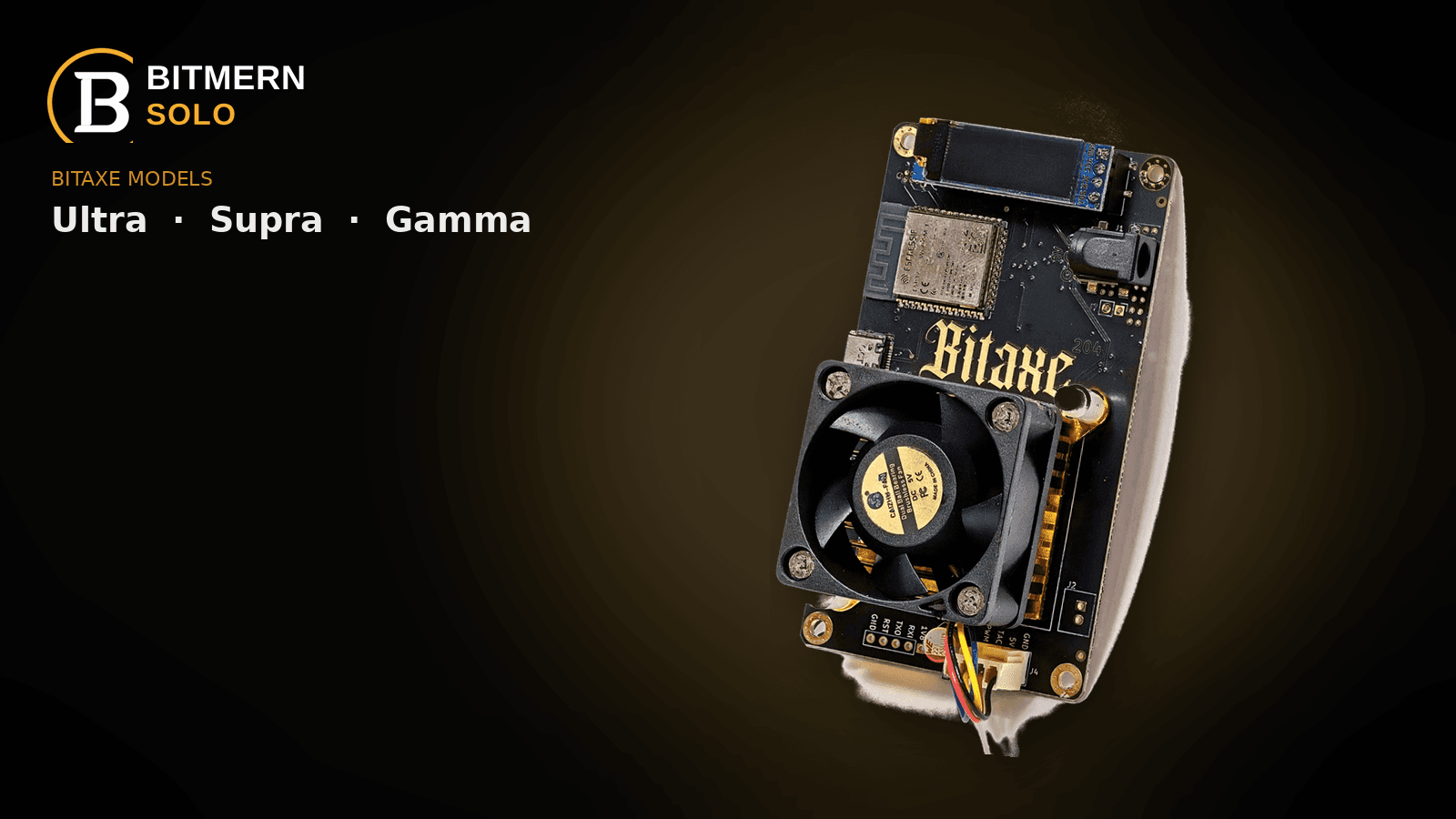
You already know a Bitaxe can talk stratum. The next question is which board belongs on your desk: Ultra, Supra, or Gamma.
Pick by chip generation and how you live with the box - not by invented monthly BTC. Ultra (BM1366) is the budget / quiet entry (~400–500 GH/s, ~12 W class). Supra (BM1368) is the mid step (~625–775 GH/s, still ~12 W class). Gamma (BM1370) is the single-chip hashrate lead (~1.0–1.2 TH/s, ~15–21 W class). All three run the same AxeOS path to Bitmern Solo.
This is a model-fit guide for home solo miners. Spec bands below are drawn from public Bitaxe community and retailer comparison guides (for example D-Central model pages) - treat them as typical stock ranges, not factory guarantees for every board, firmware, or cooling setup. No invented BTC/month, network odds, or Bitmern block-win claims.
Bitmern Solo is solo infrastructure: flat 1% fee, you keep 99% of blocks you find. Wiring AxeOS: Bitaxe AxeOS setup. Coin choice: Which coin for a Bitaxe. Ports: VarDiff & stratum ports.
Who this is for
This post is for operators who:
- Already decided solo (or are leaning that way) and need a board decision, not a payout-model debate
- Care about desk noise, power class, and entry cost as much as raw hashrate
- Want one mental model: same firmware, same stratum username pattern, same Bitmern Solo account - different chips
- Will not treat a home Bitaxe as a rack farm substitute
If you need weekly fractional payout certainty, shared pools may still fit better (Solo Mining vs Pool Mining). If you already own a board and only need pool fields, skip ahead to the AxeOS section or open the setup guide directly.
Bitmern Solo’s shop is Phase 1 template stock today - do not assume a specific Ultra / Supra / Gamma SKU is listed as in-stock there. Use this comparison to choose hardware from the open Bitaxe ecosystem; point whatever you buy at Bitmern Solo the same way.
Comparison table - chip, hashrate band, power class
Stock bands from public Bitaxe community / retailer guides (D-Central comparison and encyclopedia-style tables are representative sources). Bands, not promises.
ModelChipStock hashrate bandPower class Ultra (200)BM1366~400–500 GH/s~12 W class Supra (400)BM1368~625–775 GH/s~12 W class Gamma (600)BM1370~1.0–1.2 TH/s~15–21 W classOptional context if you are browsing the wider line: GT is roughly a dual BM1370 class (~2× single-chip Gamma hashrate territory, higher power). Hex is multi-chip - more aggregate hashrate, more watts. Neither changes the Ultra / Supra / Gamma desk decision for most first boards; skip them until you want density over quiet single-board simplicity.
Overclocking, aftermarket cooling, and firmware forks can move any row. This post stays on stock-class bands so the buy decision stays comparable.
Ultra vs Supra vs Gamma - who should buy which
Same software story. Different silicon and power personality.
Ultra (200) - BM1366 - budget and quiet entry
Choose Ultra when entry price and lowest absolute draw matter more than topping the single-chip ladder. Public guides put stock Ultra around ~400–500 GH/s in a ~12 W class. That is enough to learn AxeOS, 2.4 GHz Wi‑Fi habits, and Bitmern Solo workers without treating the board as a space heater.
Ultra fits:
- First Bitaxe, learning solo ops
- Tight power budget or always-on desk setups where every watt is noticed
- Operators who accept lower hashrate for a simpler, cooler footprint
It is not “too small to connect.” It is small relative to network hashrate - solo variance stays high on any of these boards. Ultra just keeps the learning curve and the wall-watt story gentle.
Supra (400) - BM1368 - mid step, still ~12 W class
Choose Supra when you want a clear hashrate step up from Ultra without jumping into Gamma’s higher power band. Community / retailer tables typically list Supra stock around ~625–775 GH/s while staying in the ~12 W class - more work per day at a similar absolute draw story to Ultra.
Supra fits:
- Buyers who found Ultra “fine but want more GH/s” without a full Gamma step
- Multi-board fleets where low per-unit watts keep the PSU and heat story calm
- Desk quiet priorities that still want the BM1368 generation
If Ultra and Supra are close in your local price, Supra is usually the efficiency-minded upgrade inside the same power neighborhood. Verify live listings - this post does not invent street prices.
Gamma (600) - BM1370 - hashrate lead on one chip
Choose Gamma when maximum single-chip stock hashrate is the priority and you can live with a ~15–21 W class draw. Public guides put stock Gamma around ~1.0–1.2 TH/s on the BM1370 - the generational step most comparison pages highlight versus BM1366 / BM1368 boards.
Gamma fits:
- Operators who want the strongest common single-board Bitaxe for SHA-256 solo
- Setups with decent cooling headroom (heatsink / fan as the board expects)
- People who will run one serious desk unit rather than many tiny ones
Trade-off is honest: more hashrate, higher power class, more heat to manage than Ultra/Supra’s ~12 W neighborhood. Still a home board - not a rack S21 substitute, and not a forecast of block finds.
Quick decision frame
PriorityLean toward Lowest entry / gentlest wattsUltra More GH/s, still ~12 W classSupra Max single-chip stock TH/sGamma Desk quiet + multi-unit fleetsUltra or Supra first One board, push hashrateGammaNone of the three turns solo into a salary. They change how much work you submit and how hot the shelf gets - not the lottery physics of finding a block.
Same AxeOS → Bitmern Solo
Firmware does not fork by Ultra vs Supra vs Gamma for pool fields. Once the board boots AxeOS, Bitmern Solo wants the same three values on every model.
For BTC easy-start:
stratum+tcp://btc.bitmernsolo.com:3132
stratum+tcp://btc.bitmernsolo.com:3132
UsernameYOUR_WALLET.worker1
Passwordx
Never treat :3102 as the Bitaxe default. Start BTC on :3132. Username is your coin receive address, one dot, then a worker label. Password is exactly x. Flat fee on finds remains 1% / you keep 99%.
Full field walkthrough, Wi‑Fi (2.4 GHz) fails, and verify steps: How to Point a Bitaxe at Bitmern Solo (AxeOS Setup). Port ladder detail: Bitaxe VarDiff & Stratum Ports.
Swap model later? Keep the same account, same username pattern, same easy-start port until the new board is stable - only the chip (and what AxeOS reports for hashrate) changes.
Coin fit - SHA-256 first
Typical Ultra / Supra / Gamma boards hash SHA-256. On Bitmern Solo that means BTC, BCH, DGB, or XEC - not Scrypt LTC/DOGE, not RandomX, not KawPow, unless you literally own different hardware.
CoinEasy-start (Bitaxe-relevant) BTCstratum+tcp://btc.bitmernsolo.com:3132
BCHstratum+tcp://bch.bitmernsolo.com:13123
DGBstratum+tcp://dgb.bitmernsolo.com:4052
LTC / DOGEScrypt ASICs - not typical Bitaxe Ultra/Supra/Gamma
Algo mismatch cannot be fixed by buying Gamma instead of Ultra. Chip generation changes hashrate and watts; it does not unlock Scrypt. Deep dive: Which Coin Should You Solo Mine on a Bitaxe?.
For BTC odds framing, use the live solo chances calculator on bitmernsolo.com with your hashrate - this article will not invent expected times or dollars for any model.
FAQ
Is Gamma “worth it” over Supra for solo?
If you want more stock hashrate on one chip and accept the higher power class (~15–21 W vs ~12 W class), Gamma is the usual single-board step-up in public comparisons. “Worth it” still depends on your electricity, noise, and budget - not on a blog inventing monthly BTC.
Will Ultra ever find a block on Bitmern Solo?
Solo finds are rare lottery outcomes for home hashrate on large networks. Bitmern Solo changes fee and infrastructure (flat 1%, stratum, monitoring) - not network difficulty. Do not buy Ultra (or any model) on a forecasted find schedule.
Do I need different AxeOS settings per model?
No. Same stratum URL pattern, YOUR_WALLET.worker1, password x. Start BTC on :3132. Model choice is hardware; pool fields are shared.
What about GT or Hex?
More hashrate, more power, more heat and density. Fine if that is the goal. For a first quiet desk miner, Ultra / Supra / Gamma remain the clearer three-way choice.
Does Bitmern Solo sell these boards?
Check bitmernsolo.com/shop for current listings. Phase 1 may show empty miner stock - the stratum service is what this guide assumes you will use once you own a board from the Bitaxe ecosystem.
Soft next step
Match the board to your desk constraints, then point it the same way every other Bitaxe points: AxeOS → Bitmern Solo easy-start port, wallet.worker username, password x. Ultra for gentle entry, Supra for mid hashrate in the ~12 W class, Gamma when single-chip stock TH/s comes first.
Flat 1% fee. You keep 99% of blocks you find. Spec bands are community / retailer guide ranges - verify your unit after it ships.
Start mining
Create an account, register your coin wallet, and point AxeOS at Bitmern Solo when the board is on the LAN.
Start Mining → https://www.bitmernsolo.com/
Browse hardware listings when available: Shop → https://www.bitmernsolo.com/shop